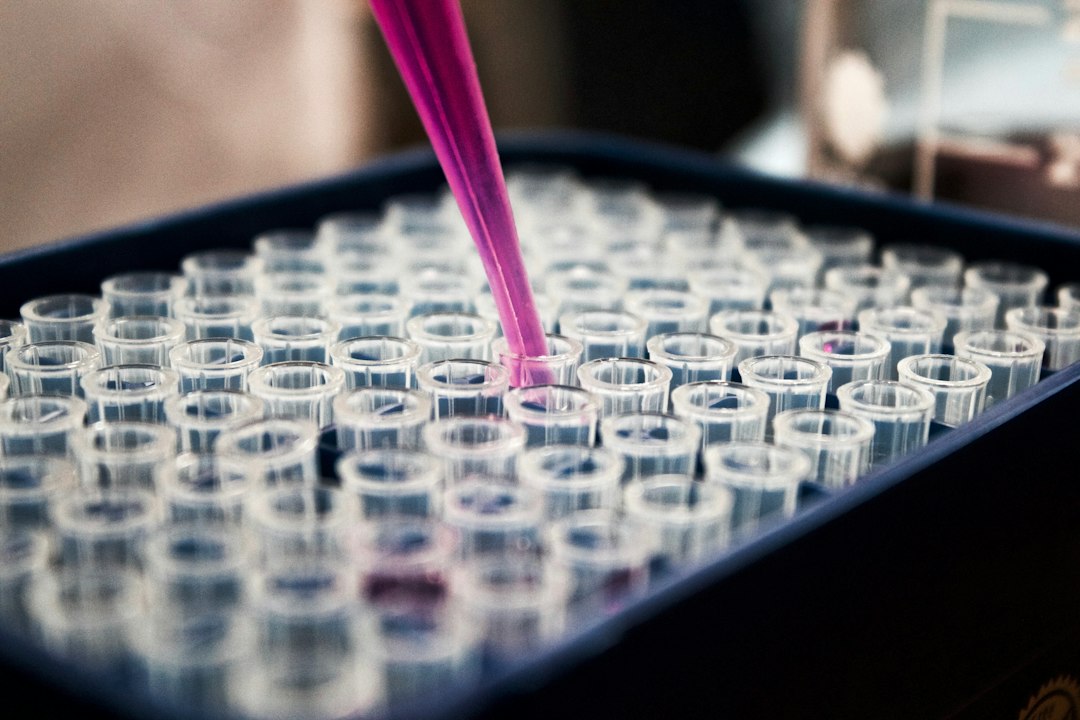
Peptide adsorption to labware is an easy source of error to overlook. A sample can be prepared correctly, stored at the intended temperature, and analyzed with a validated instrument method, yet still deliver unexpectedly low recovery because part of the peptide has attached to the container wall. The risk is especially important when concentrations are low, sample volumes are small, or a workflow includes several transfers.
For research teams, the practical lesson is simple: tubes, vials, pipette tips, plates, and filters are part of the analytical system. Their materials and surface properties should be evaluated rather than treated as neutral. This guide explains why surface loss occurs, how it can affect results, and how to build a proportionate labware-recovery check into a peptide research workflow.
What Is Peptide Adsorption to Labware?
Adsorption occurs when peptide molecules accumulate at an interface, such as the boundary between a solution and glass or plastic. This is different from absorption, in which material penetrates into another phase. Electrostatic attraction, hydrophobic interactions, surface charge, peptide sequence, pH, ionic strength, solvent composition, and contact time can all influence adsorption.
Because peptides differ in net charge, hydrophobicity, conformation, and modifications, no single container material is universally best. A comparative study of several radiolabeled peptides found important differences in recovery among borosilicate glass, flint glass, polypropylene, polystyrene, polycarbonate, and polyallomer. The best-performing surface depended on the peptide. That variability is why a label such as “glass” or “plastic” alone is not enough to predict recovery.
Why Low-Concentration Samples Are Vulnerable
Surface area does not scale down as quickly as sample quantity. At low concentration, the number of available peptide molecules may be small relative to the exposed container surface. A modest absolute amount of adsorption can therefore represent a large percentage of the total analyte.
Published work on cationic peptides has reported rapid and substantial adsorption to common glass and plastic surfaces under some experimental conditions, including losses of 90% or more at concentrations typical of certain laboratory assays. This does not mean every peptide or method will show that degree of loss. It does show that dilution can change apparent recovery in a nonlinear way and that a result near an assay’s lower range deserves a surface-loss check.
Before preparing a dilution series, researchers should also review the material’s identity and documented form. Sequence, terminal modifications, counter-ion information, and batch documentation can affect how an experiment is designed. Our guide to reading peptide sequences and modifications provides a useful starting point.
Container Material Matters, but Context Matters More
Polypropylene is frequently chosen for peptide workflows, and specialized low-binding plastics may reduce losses in some applications. Borosilicate glass can perform well for some peptides, while other peptides may bind more strongly to a glass surface. Polystyrene, polyethylene, PTFE, and other materials can also behave differently. Even two containers made from the same nominal polymer may differ because of manufacturing processes, additives, surface treatments, geometry, or lot variation.
Drying adds another variable. A study of peptide adsorption during sample drying found that the preferred vial material depended on whether the workflow used freeze-drying or centrifugal evaporation. This is a useful reminder that container selection should be matched to the complete procedure, not copied from an unrelated protocol.
Transfers, Contact Time, and Geometry
Each transfer creates another surface contact. Moving a sample from a stock vial to a dilution tube, then to a plate, then through an autosampler vial can compound losses. Small-volume vessels with a large wetted surface area may be particularly demanding. Extended storage or slow preparation can also increase the time available for surface interactions.
A practical workflow therefore minimizes unnecessary transfers and uses consistent vessel geometry during validation and routine analysis. Pipette tips, reservoir troughs, filter membranes, caps, and tubing should be considered alongside the main sample vial. If one component changes, recovery should be rechecked rather than assumed to be unchanged.
How to Evaluate Labware-Related Sample Loss
A small comparison study can identify whether adsorption is materially affecting an experiment. The exact design should match the analytical method, but a useful framework includes:
- Define the test range. Include the concentrations and sample volumes that will actually be used, with special attention to the lowest level.
- Compare relevant materials. Test the intended container against at least one reasonable alternative, such as borosilicate glass, standard polypropylene, or validated low-binding plastic.
- Control contact history. Keep temperature, buffer, mixing, contact time, number of transfers, and vessel geometry as consistent as possible.
- Measure recovery. Use an appropriate validated analytical approach, such as HPLC, LC-MS, or another fit-for-purpose method. Include a time-zero or minimal-contact control where feasible.
- Check repeatability. Replicates help distinguish surface effects from pipetting variability or instrument noise.
- Document the result. Record manufacturer, catalog number, material, lot, fill volume, contact time, and any surface treatment in the method or SOP.
The objective is not to prove that one material is always superior. It is to demonstrate acceptable recovery for a specific peptide, concentration range, matrix, and workflow.
Interpreting Unexpectedly Low Results
Adsorption can resemble poor solubility, degradation, incomplete transfer, or an instrument problem. These possibilities should be separated systematically. A concentration-dependent drop in recovery, improvement after changing the container, or loss that increases with repeated transfers may point toward a surface contribution. In contrast, new chromatographic peaks or mass changes may suggest chemical degradation or transformation.
Surface loss and solubility can also interact. Aggregated or partially precipitated material may behave differently from a fully dispersed sample. Researchers evaluating low recovery should review pH, buffer composition, ionic strength, and visible or subvisible aggregation alongside the container study. See our laboratory guide to peptide solubility for a broader discussion of those variables.
What to Record in a Reproducible SOP
A reproducible method should name the actual labware, not simply state “tube” or “vial.” At minimum, record the material, manufacturer, catalog number, nominal volume, sample fill volume, cap or closure type, and whether the surface is treated or marketed as low binding. Note the maximum contact time, permitted number of transfers, mixing method, temperature, and any drying step.
When a method is transferred to another laboratory, container equivalence should be verified. A substitute that looks identical may not provide equivalent recovery. This verification is particularly important when the analytical result is used to compare batches, establish stability trends, or interpret a low-concentration endpoint.
Key Takeaway
Peptide adsorption to labware is not merely a handling inconvenience; it can become a hidden analytical variable. The safest approach is peptide-specific and method-specific: test recovery under realistic conditions, reduce unnecessary surface contacts, document exact materials, and revalidate meaningful changes. Treating labware as part of the method improves traceability and helps prevent false conclusions caused by sample loss.
For research purposes only. Not for human consumption.
Selected Scientific References
- Goebel-Stengel M, et al. The importance of using the optimal plasticware and glassware in studies involving peptides. Analytical Biochemistry. 2011.
- Kristensen K, et al. Adsorption of cationic peptides to solid surfaces of glass and plastic. 2015.
- van Midwoud PM, et al. Adsorption of peptides at the sample drying step. Journal of Pharmaceutical and Biomedical Analysis. 2009.
- Wang G, et al. Assay for characterizing adsorption properties of surfaces using liquid chromatography. 2024.
[…] air-liquid interfaces, while repeated transfer between containers increases contact with surfaces. Adsorption to glass or plastic can be important for some low-concentration samples. Freeze-thaw history may also change recovery […]
[…] can influence the chromatogram. For a related sample-handling variable, see our guide to peptide adsorption to labware. A high area percentage does not automatically confirm identity, quantity, sterility, or the […]