Peptide counterions are easy to overlook when a certificate of analysis emphasizes sequence, molecular mass, and HPLC purity. Yet a research peptide can arrive as a trifluoroacetate, acetate, or another salt form. Recording that form helps laboratories compare materials more carefully and interpret what a weighed powder actually contains.
This guide explains the distinction between peptide identity and salt composition, the measurements that answer different questions, and practical documentation choices for reproducible experiments. For research purposes only. Not for human consumption.
What are peptide counterions?
A counterion is an ion with the opposite charge to a charged molecule. When a peptide carries positive charges, negatively charged species such as trifluoroacetate or acetate can balance them. The peptide sequence and the counterion are separate parts of the material description.
“Acetate salt” should not be confused with “acetylated peptide.” Acetylation is a covalent modification, whereas acetate as a counterion describes a salt. A request for one does not establish the other. Record terminal modifications and salt form in separate fields to prevent ambiguity when ordering or exchanging samples.
Why TFA and acetate appear in peptide documentation
Trifluoroacetic acid, commonly abbreviated TFA, is used in peptide manufacturing, including cleavage and reversed-phase purification. Following isolation, trifluoroacetate may remain associated with the peptide. Acetate and chloride are other possible counterions. Biosynth’s peptide analytics documentation describes these analytical distinctions and explains why peptide, counterion, and water content belong in a mass balance.
A salt name alone does not specify its amount. Nor does “acetate” establish that residual trifluoroacetate is absent. Before treating two lots as equivalent, request the measured composition and the reporting basis. A label is a useful starting point; a batch-specific analytical result is stronger evidence.
HPLC purity is not a counterion measurement
A peptide HPLC area percentage describes detected chromatographic peaks under a particular method. It does not automatically quantify all the nonpeptidic material in a dried sample. Counterions and residual moisture can contribute to gross powder mass without appearing as peptide impurity peaks in that assay.
Bachem’s handling guidance explicitly distinguishes HPLC purity from peptide content. This matters when weighing a material for an analytical experiment: a highly pure chromatogram does not establish that the entire measured mass is peptide.
Keep three questions separate: Is the intended peptide present? What other peptidic species are detected? How much of the powder is peptidic material? Our research peptide COA guide helps organize the supporting documents.
Use an explicit basis for concentration calculations
Consider a hypothetical 10.0 mg powder sample with documented net peptide content of 80.0%. On that stated basis, the sample contains 8.00 mg of peptidic material. This calculation does not prove that all 8.00 mg is the intended sequence. It also does not establish the composition of the remaining mass.
Check the supplier’s definition before applying additional corrections. A target-specific assay may already account for factors that are reported separately elsewhere. Multiplying by another percentage without understanding the definitions can duplicate a correction.
For molar calculations, document whether the molecular weight represents the peptide alone or a specified salt form. Match it to the mass basis used. Our peptide concentration measurement guide discusses this broader measurement problem.
Which analytical methods can identify counterions?
Counterion testing needs an analytical method that measures the relevant ions. Ion chromatography is one established option. Shimadzu’s application example examines counterions in synthetic linear and cyclic peptides, including simultaneous measurement of trifluoroacetate and chloride.
Thermo Scientific’s Application Note 115 demonstrates ion-chromatographic separation of trifluoroacetate, acetate, and fluoride in selected peptide samples. Its sample preparation, calibration, and recovery experiments illustrate why an instrument name alone is insufficient evidence that a method suits every matrix.
Ask the laboratory about selectivity, calibration, quantification limits, and recovery for the material being tested. Report units clearly: a mass percentage and a molar ratio per peptide molecule are different expressions. Bio-Synthesis’s counterion analysis guidance describes these reporting options and separates counterion testing from identity, purity, and water measurements.
Evaluate salt exchange with measurements
If a project requires a different salt form, define the intended composition before the exchange and verify it afterward. Assess both the replacement counterion and residual original ions. Also review peptide recovery and the identity and purity evidence needed for the experiment.
Do not assign a universal “better” counterion to every sequence and assay. Instead, treat a change in salt composition as a documented material change. A practical comparison keeps the peptide sequence, concentration basis, buffer, and preparation history as consistent as possible. Where differences remain, describe them rather than attributing every unexpected result to the counterion.
A checklist for reproducible laboratory records
- Material: sequence, terminal modifications, lot identifier, and declared salt form.
- Composition: measured counterion content, units, water result where relevant, and definition of peptide content.
- Evidence: method identifier, analytical date, calibration basis, and applicable reporting limits.
- Preparation: weighed mass, final volume, buffer, measured pH where relevant, and calculation assumptions.
- Comparison: any change in salt form, supplier, analytical method, or sample handling between experiments.
Before combining data from different lots, review this record alongside the assay results. If composition is unknown, label the uncertainty explicitly. A clear statement of what was measured is more useful than a confident concentration estimate built on undefined percentages.
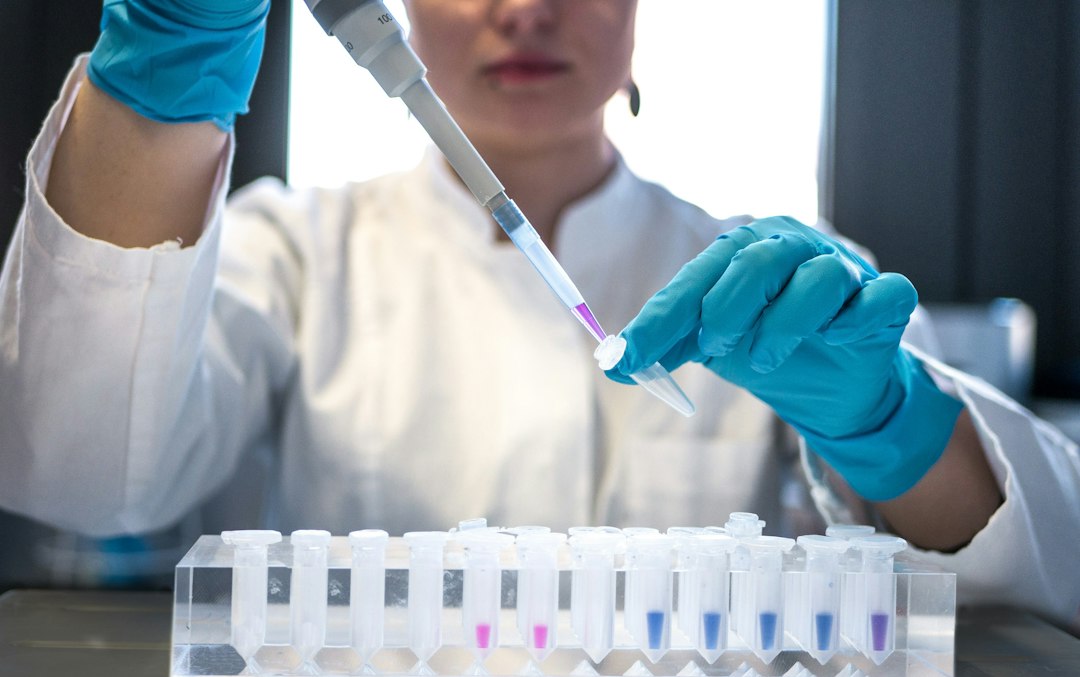
Featured image: laboratory sample preparation, photographed by Julia Koblitz on Unsplash. The photograph is illustrative and does not document testing of a specific peptide.